Violating SOLID for Performance: When It’s Okay and How to Isolate It

Discover when it’s justified to break SOLID principles for performance in C#. Learn how to measure, isolate, and document exceptions, see real-world trade-offs, and keep your codebase maintainable, even in the engine bay of high-throughput systems.

July 10, 2025 · 10 min

Avoiding N+1 Queries in EF Core: Include() vs SplitQuery()

A practical guide to fixing N+1 queries in EF Core using Include and AsSplitQuery, with code samples and performance tips.

July 8, 2025 · Last modified: July 10, 2025 · 11 min

Single Responsibility Principle: One Reason to Change

TL;DR: SRP means each class or module should have only one reason to change. Split validation, data access, and business logic into separate classes. SRP improves maintainability, testability, and scalability. Use C# 12 features like primary constructors and records for clean separation. Avoid “God” classes and mixing unrelated responsibilities. SRP is the foundation for applying other SOLID principles. Refactor large classes by extracting focused components and using dependency injection. The Single Responsibility Principle gets misunderstood more than any other SOLID principle. It’s not about doing one thing, it’s about having one reason to change. When your class changes for multiple business reasons, you’ve violated SRP and created a maintenance nightmare. ...

July 7, 2025 · Last modified: September 20, 2025 · 8 min

Avoiding Boxing with Struct Dictionary Keys in C#: Performance and Best Practices

Discover why structs as dictionary keys can cause hidden allocations in C#. Learn how to implement IEquatable, use readonly and record structs, and write allocation-free, high-performance code for hot paths.

July 6, 2025 · 4 min

Guard Clauses in C#: Cleaner Validation and Fail-Fast Code

Discover how guard clauses in C# simplify validation and error handling. Learn to write fail-fast code, avoid nested conditionals, and keep business logic clean with modern language features and reusable helpers.

July 6, 2025 · 4 min

Add & Modify HTTP Headers in ASP.NET Core Middleware

This guide explains how to add and modify HTTP headers in ASP.NET Core using custom middleware. Covers dynamic header injection, security best practices, CORS configuration, and middleware pipeline ordering for robust API responses.

July 5, 2025 · 11 min

Debug ASP.NET Core Middleware Execution Flow

TL;DR Middleware order in ASP.NET Core directly affects authentication, CORS, routing, and logging. Register exception handling, HTTPS redirection, and logging middleware early in the pipeline. Place CORS before authentication and routing to avoid preflight and header issues. Authentication must come before authorization and routing for secure endpoints. Use tools like MiddlewareAnalysis and custom logging middleware to debug pipeline flow. Common mistakes include routing before authentication, CORS after auth, and late exception handling. Correct middleware order prevents security holes, debugging nightmares, and production outages. The Hidden Culprit Behind Mysterious Pipeline Failures Picture this: your ASP.NET Core API works perfectly in development, but authentication randomly fails in production. CORS headers appear inconsistently. Some endpoints return 404s that should work. The logs show everything should be working correctly. ...
July 4, 2025 · Last modified: September 20, 2025 · 9 min
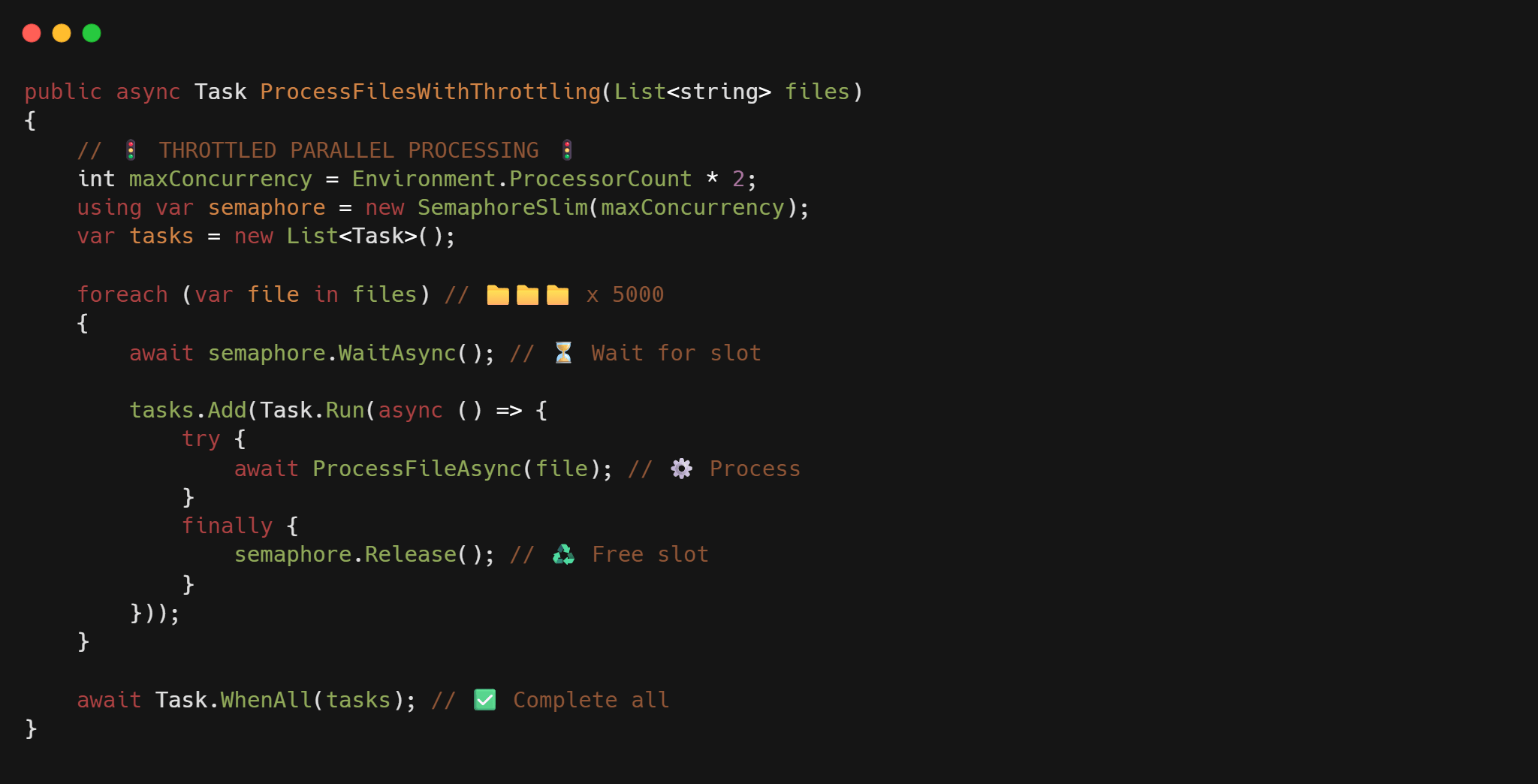
Diagram showing controlled parallel file processing with throttling compared to naive approaches

Efficient High-Volume File Processing in C#

TL;DR: Efficient C# File Processing Strategies Prevent system crashes: Avoid naive parallel processing that launches thousands of concurrent file operations. Optimize throughput: Use SemaphoreSlim to control concurrency (start with 2x CPU cores) for balanced performance. Reduce memory consumption: Implement true async I/O with useAsync: true and process files line-by-line instead of loading them entirely. Minimize database overhead: Batch related records from multiple files before making database calls. Maximize system resources: For production systems, implement adaptive throttling that responds to CPU/memory conditions. Leverage modern C# features: Use IAsyncEnumerable for efficient streaming and TPL Dataflow for complex processing pipelines. Ever tried to build an import tool that needs to process thousands of CSV files at once? I have, and I learned the hard way that simply starting a thousand file operations simultaneously is a recipe for disaster. ...

July 4, 2025 · Last modified: September 19, 2025 · 18 min

Correct Middleware Order in ASP.NET Core Apps

Discover the optimal middleware order for ASP.NET Core. See why each step matters, how to avoid common pitfalls, and use a proven pipeline template for secure, fast, and maintainable web APIs.

July 3, 2025 · Last modified: August 28, 2025 · 3 min

13 Practical Tips for ASP.NET Core HTTP Logging

TL;DR - Practical Tips for ASP.NET Core HTTP Logging Middleware Use EnableBuffering() to safely log request bodies and reset stream position after reading. Capture response bodies by swapping HttpResponse.Body with a MemoryStream and restoring after logging. Always filter or redact sensitive data before logging HTTP bodies. Set size limits and skip large or binary payloads to avoid performance issues. Filter logs by endpoint, HTTP method, or custom attributes for clarity. Built-in HttpLogging is simple; custom middleware offers full control and advanced filtering. Use structured logging and external services for production monitoring. Wrap middleware in extension methods for clean, configurable registration. Leverage PipeReader and System.IO.Pipelines for more efficient memory usage. Use Span<T> and ArrayPool<T> for zero-allocation processing of large payloads. Consider implementing request sampling in production to reduce log volume. Use a complete middleware implementation that combines all best practices. 1. How does EnableBuffering help you log request bodies in ASP.NET Core? EnableBuffering allows you to read request bodies multiple times without breaking the pipeline. ...

July 2, 2025 · Last modified: September 20, 2025 · 15 min
×